
There is a moment in immigration that nobody tells you about. Not the paperwork, not the homesickness, not the first confusing trip to an American grocery store. It is the moment you realize you are going to have to rebuild not just your life but your idea of yourself. The person you were in Spain does not translate directly. You are starting from a line on a beach, and the tide is already coming in.
That is the book. It is not a guide. It is not a success story with lessons formatted for LinkedIn. It is the experience of standing at that line and deciding which direction to walk.
Why I Wrote It as a Book
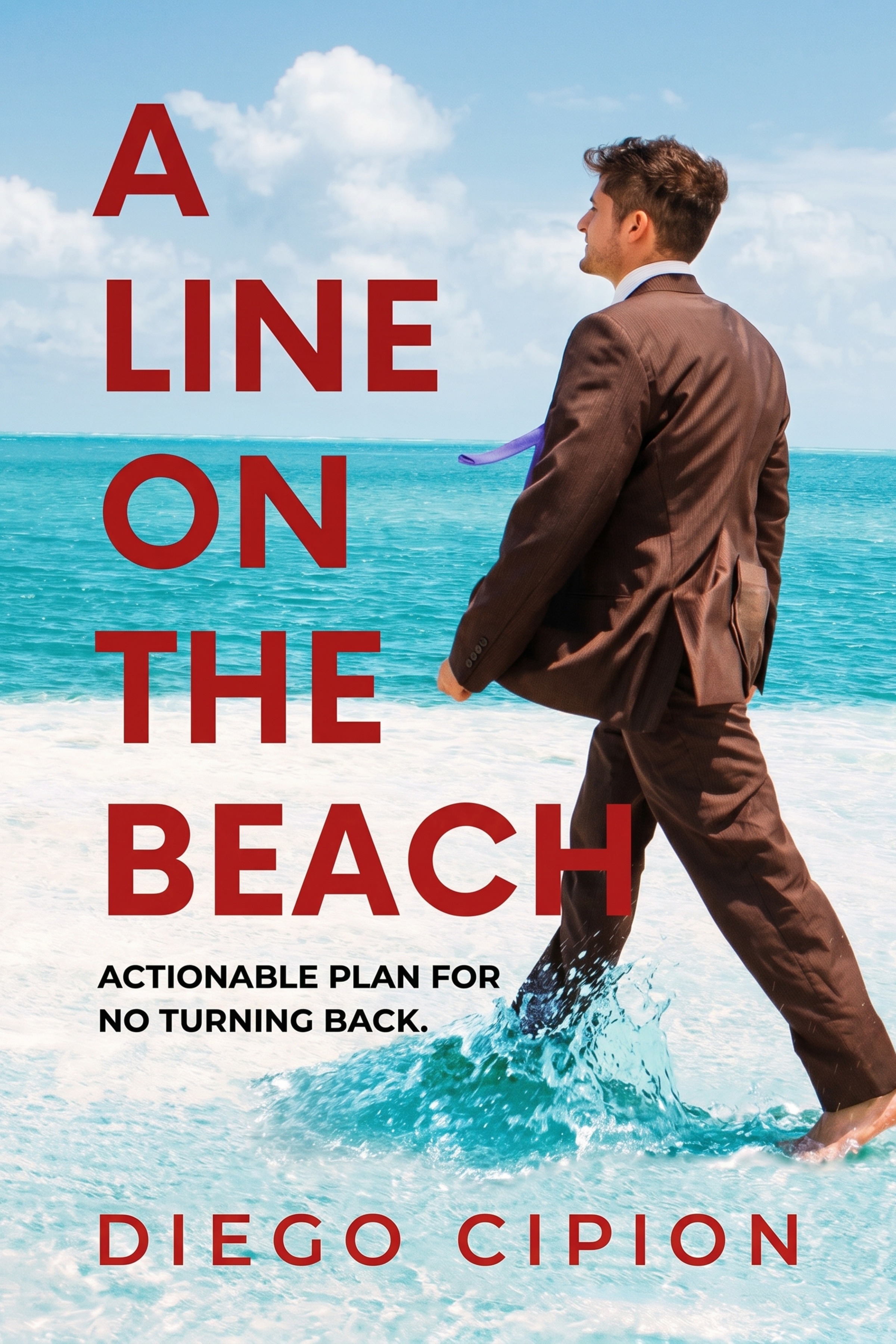
A Line on the Beach
Immigration, depression, reinvention, and what it actually takes to rebuild in a new country.
Read it on Amazon →The things I needed to say about immigration, about the depression that preceded leaving Madrid, about the specific loneliness of being professionally accomplished in one context and invisible in another: none of it fit in a post. Some experiences need the form of a book because the form gives the reader permission to stay with something uncomfortable for longer than a screen allows. A post requires you to resolve things. A book allows you to sit in them.
La linea en la playa was my first published book. Writing it was part of understanding what had happened to me, which is another way of saying I did not fully understand what I was writing while I was writing it. Understanding came after.
The Madrid Years
The thinking in this book — building credibility from scratch in a new context — shapes how I build GEO programs for clients today.
See how Cipion builds authority for brandsI had a life in Madrid. Theater, work, a city I knew by sound and by the particular quality of light in November. Leaving was not a clean break. It was a series of small decisions that became a large one, and then an irreversible one.
The depression I went through in Madrid before leaving was real and serious and I do not want to soften it in a summary. The book does not soften it either. What it tries to do is find the thing that was built out of that period. Not in the sense of "what I learned" (that framing flattens it). In the sense of: something was built. I am not sure what to call it. The book is the attempt to name it.
What Immigration Taught Me About Marketing (the Honest Version)
Building something in a new market is an act of translation. You know things about how the world works that do not transfer directly. You have to figure out which parts of what you know are portable and which parts were specific to the context you left behind. The confidence that came from being known in Madrid was not available in Miami. I had to earn it again with different people in a different language in a different professional culture.
That experience made me a better strategist. I learned to question first principles rather than assume they applied. I learned to listen before proposing. I learned that competence in one context does not automatically establish credibility in another, which is precisely what GEO is about: you cannot assume AI systems know who you are just because people in your industry do. You have to make yourself legible to systems that have no prior relationship with you. Immigration teaches you that. It is a useful lesson.
A Line on the Beach (English edition) Available on Amazon → La linea en la playa (Edicion en espanol) Disponible en Amazon →