00The whole blueprint on one page
An AI short film doesn't fail in the prompt. It fails between shots: the same person with a different face, the phone that changes hands, the room that isn't the same room. This whole process exists to stop that. Ten steps, in this order, each with its template below.
- Story6 lines with a twist
- Riskswhat AI gets wrong
- Anchorsfaces, place, object
- Biblewhat's true in each shot
- Shotsa list with risk
- Promptsframe and motion
- Pilotonly the hard ones
- Storyboardand contact-sheet review
- Animatein batches of 8
- Sound and auditbefore you show it
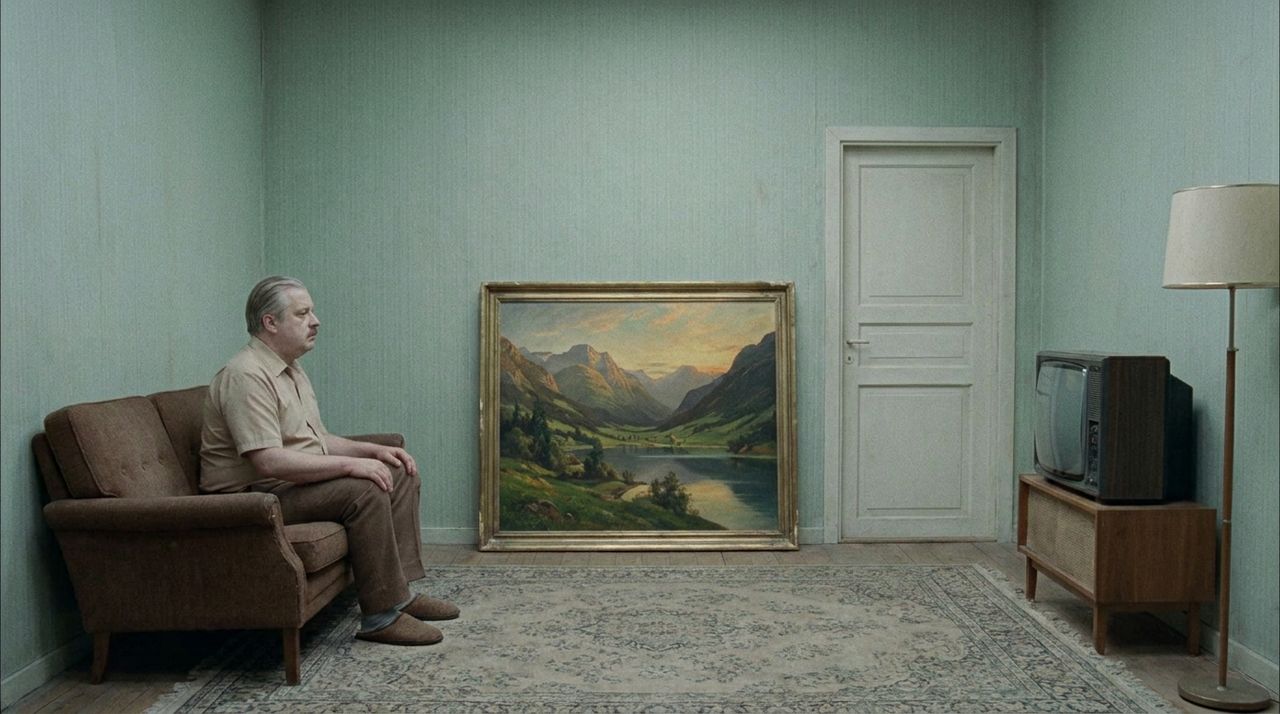
The example I use throughout: Shoebox, a dialogue-free short about an ordinary man who opens a hole in his wall and finds he lives inside a shoebox. The style is Roy Andersson's: locked-off camera, flat light, muted palette.
01Tell it in 6 lines, with a twist
Before you open any tool, the story fits in six lines: a hook, the development, a twist that changes the meaning of what you've already seen and an open ending. If it doesn't work read aloud, AI won't save it.
1. HOOK: [locked-off shot of a place and a person with something odd]
2. WHAT HE DECIDES: [what he does, with which objects]
3. THE FIRST CHANGE: [what breaks or opens]
4. THE ESCALATION: [what he does to go further]
5. TWIST: [what we discover that changes what we believed]
6. OPEN ENDING: [a gesture, not an explanation]

WHAT WE NEVER SHOW: [what the viewer finds out alone]
Real example: Shoebox
- Hook. Locked-off shot of a windowless living room. A man looks at a painting leaning on the floor.
- He gets up and takes a hammer, nails and a stool out of the storage room.
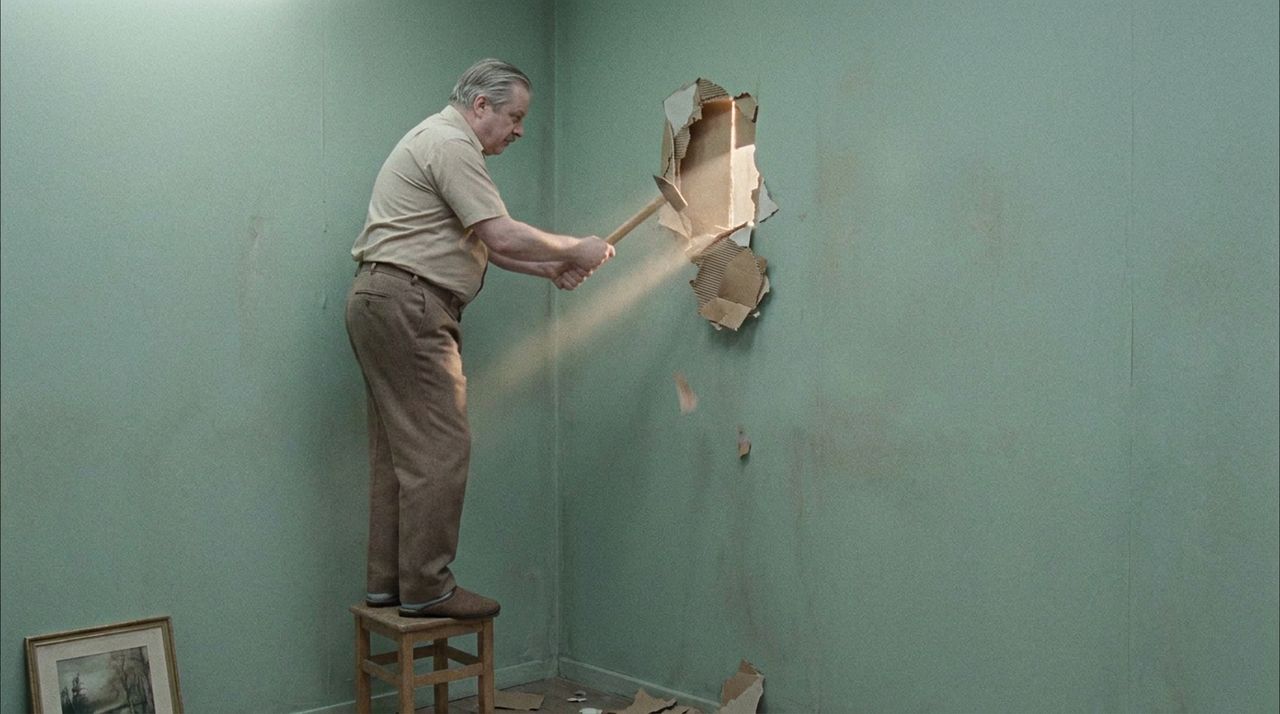
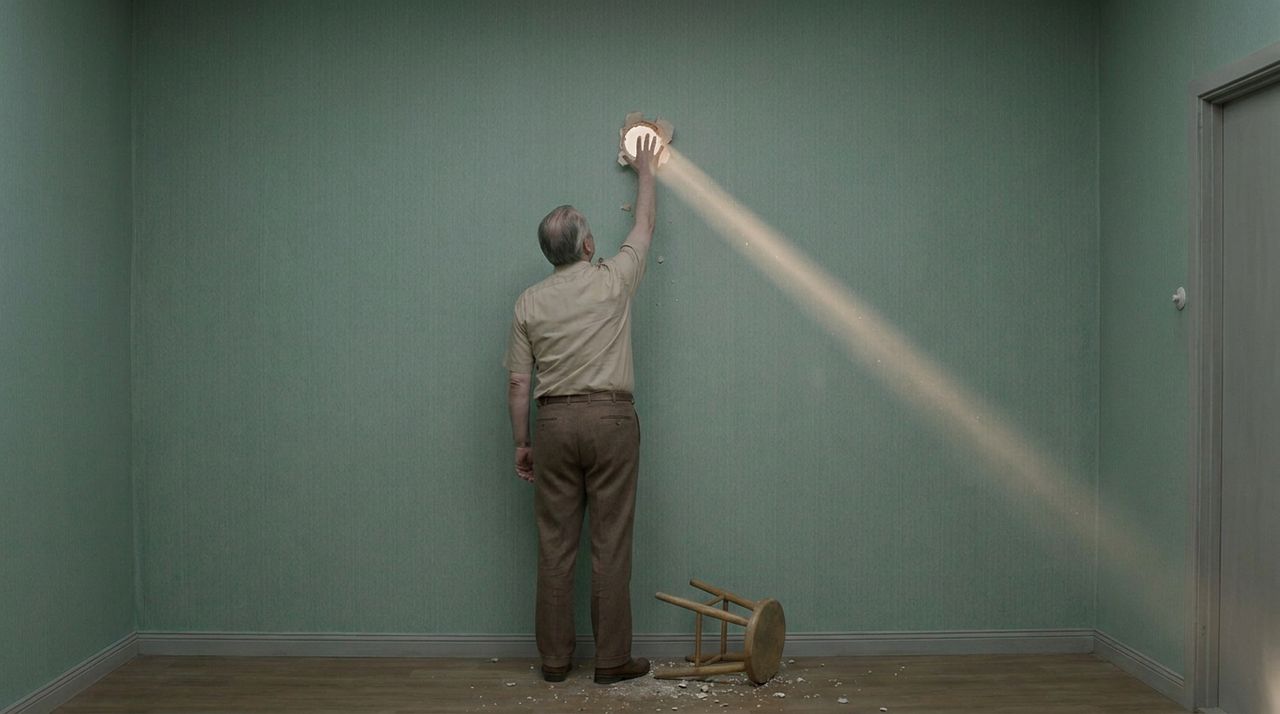
- As he hammers, a blow tears off a chunk of wall. A beam of light slants in.
- He widens the hole and pulls himself up until his eyes reach it.
- Twist. The camera exits the hole and pulls away: it's the side of a shoebox on a shelf in an alien child's bedroom.
- Open ending. A huge hand drops food through a slot in the lid.
What we never show: what he sees. Only his eyes and the light. The viewer finds out in the pull-back.
02Write down what AI gets wrong in your script
Before generating anything, run your script through this list. What AI can't do you don't ask for: you tell it another way. One bad shot among good ones shows more than a shorter film.
| If your script has… | AI usually… | Tell it like this |
|---|---|---|
| Long dialogue to camera | moves lips badly and changes the voice | voice-over, a shot from behind, or a reverse shot of the listener |
| An object passed from hand to hand | duplicates it or makes it vanish | one object per shot and a table saying where it is in each |
| A fall | makes it float | cut it: in Shoebox he drops the hammer and it hits the floor |
| A physical effect (blow, light, hole) | exaggerates it into an explosion | ask for a dry blow, no flash, and give the size of the thing in centimetres |
| Two people touching | melts the hands together | a close-up of one hand, or cut before contact |
| A change of scale | always returns the size of the face | don't let the engine do it: a digital zoom over layers |
My first attempt at La aplicación came out with 36 errors: a phone duplicated or teleporting across seven cuts, a jump across the axis, a character who reappeared, a lighting change from day to night, and every character with two or three voices. Each shot, looked at alone, was fine. The errors were between shots.
03Lock the faces, the place and the object first
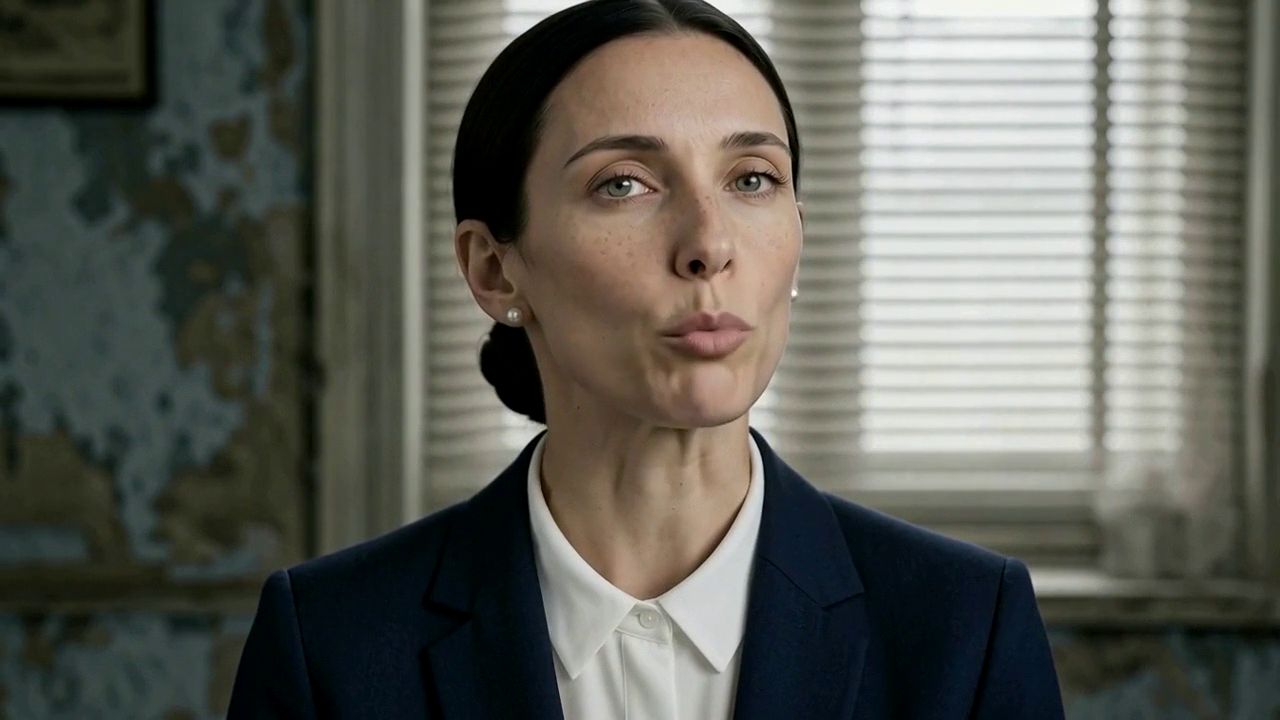
One image per character, one of the main location and one of each important object. Everything else comes from them, because viewers forgive almost anything except the same person changing face between two shots. In Shoebox there were four anchors: the man, the living room, the box from outside and the child's room.

[Who, age, build, hair, face]. [Exact clothing, garment by garment]. Full-body, standing, neutral expression, plain [colour] background, even soft light, 35mm still, fine film grain. No text, no logo.
- Plain background and flat light: an anchor is a reference photo and nothing more.
- Clothing described garment by garment, and never changed between shots.
- When something fails, redo the frame passing a good one as the reference. Never use one showing the bad version as a reference.
- If an object carries real brands (a bottle, a sign), ask for "unbranded, plain blank label". It spreads to every shot.
04The continuity bible: what's true in each shot
One sheet saying where everything is and what it looks like. It's boring, and it's what separates a short film from a pile of clips. Every prompt quotes its row.
CHARACTER: [age, face, hair, clothes garment by garment, wounds and on which side]
PLACE: [walls, furniture and where, how many doors and where, where the light comes from]
AXIS: [which side of the table/door the camera is always on]
OBJECTS: [one row per object: where it is in each shot]
LIGHT AND TIME: [the same across the scene]
VOICE: [one per character, language and tone]
Real example: Shoebox
| Element | Fixed state |
|---|---|
| Man | About 55, slightly heavy, pale, thinning hair combed back, thin moustache. Short-sleeved beige shirt, brown trousers, brown house slippers. The same in every shot. |
| Living room | No windows. Muted sea-green wallpaper, brown sofa on the left, small TV on the right, floor lamp. One white door at the back. |
| Painting | Large, worn gilt frame, a valley with a lake. Leaning on the floor until he goes to hang it. |
| Hole | About 15 cm above his head. First 3 cm, then fist-sized. |
| Beam of light | Warm white, dust floating, at 45 degrees to the floor. Always the same angle. |
Real example: tracking one object per shot
In "Attention Junkie" the phone is the protagonist. This table stopped it from changing place for no reason.
| Shot | Where the phone is |
|---|---|
| A1 to A3 | on the table, face up |
| A4 | in her hand, filming herself |
| A5 | she puts it on the table |
| B1 | on the table, face down, buzzing |
| B2 | she picks it up and looks |
| B4 to B6 | in her hand (selfie and typing) |
05The shot list, with its risk level
One shot = one framing and one action, 5 to 8 seconds. Each shot gets a risk column: the high-risk ones are the ones you test first.
# | SHOT | ACTION (just one) | SECONDS | AI RISK (low/medium/high)
P1 | Locked-off wide of [place] | [what he does] | 8 | low
P2 | ... | ... | ... | ...
Real example: 8 of the 16 Shoebox shots
| # | Shot | Action | s | Risk |
|---|---|---|---|---|
| P1 | Locked-off wide of the living room | Sitting on the sofa, he looks at the painting. Stillness. Ticking | 8 | low |
| P3 | Locked-off wide | He gets up, crosses and opens the storage-room door | 6 | medium |
| P4 | Storage room, from inside | He takes the hammer, the nails and the stool | 6 | medium |
| P6 | Medium shot of the wall | Hard blow, plaster falls, the hole opens and the beam comes out | 5 | high |
| P10 | Medium side shot | He pulls himself up until his eyes reach the hole | 6 | high |
| P12 | Turn around the head | The camera goes from behind him to his eyes in the cardboard | 5 | high |
| P14 | Continuous pull-back | From the eyes to the box on the shelf and the alien room | 8 | high |
| P16 | Black and title | SHOEBOX | 4 | none |
06The prompts: one for the frame, one for the motion
I always work in two steps: first a frame (the approved image) and then the motion from it. They're two different prompts and they're written differently. The ones below are the real Shoebox prompts.
Frame prompt, part by part
Same man and same living room as the references.
A still frame from a melancholic Scandinavian art-house film in the manner of Roy Andersson, shot on 35mm.
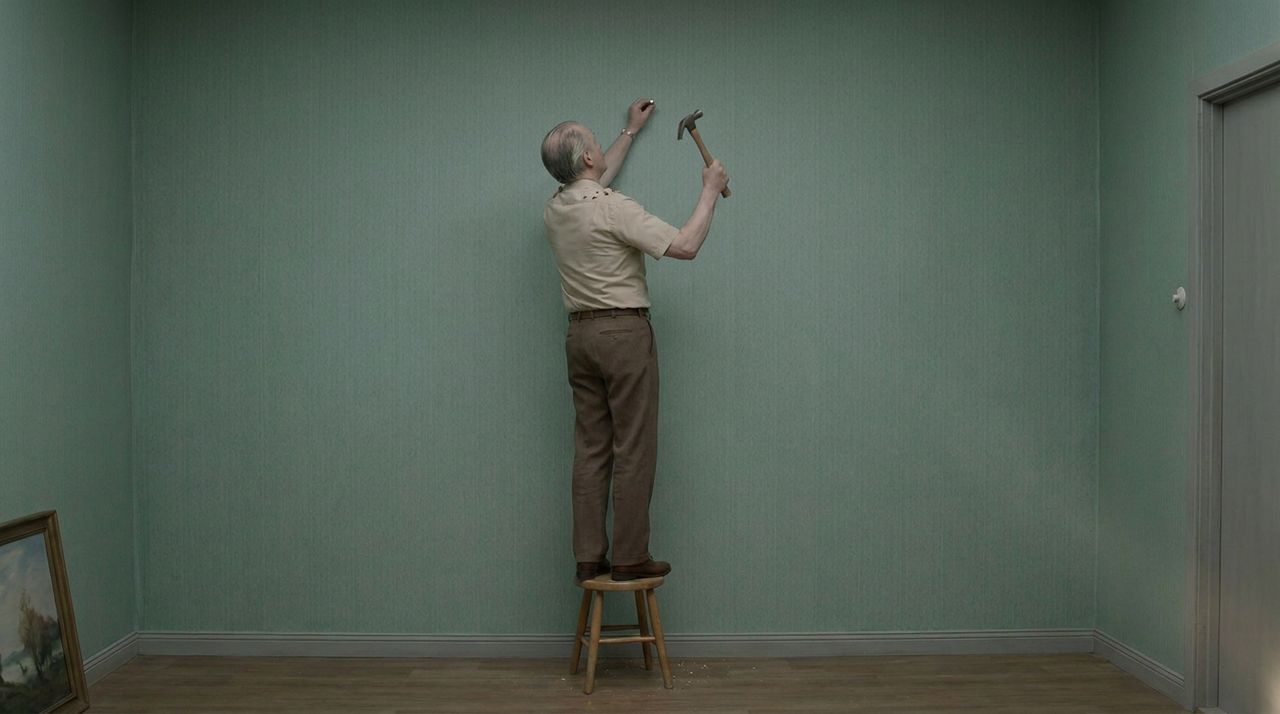
Static medium shot, frontal, of the bare pale sea-green back wall:
the man stands on a small three-legged wooden stool close to the wall, seen from slightly behind at three-quarters, his left hand holding a single nail against the wallpaper just above his head height, his right hand raising a wooden-handled hammer.
The edge of the white door is visible at the right of frame; the large gilt-framed landscape painting still leans on the floor at the left.
Flat soft diffuse light, muted beige, sea-green and grey palette, low contrast, fine film grain, deep focus.
No windows, no text, no logo, no HDR, no glow.
Same man and same living room as the references. A still frame from a melancholic Scandinavian art-house film in the manner of Roy Andersson, shot on 35mm. Static medium shot, frontal, of the bare pale sea-green back wall: the man stands on a small three-legged wooden stool close to the wall, seen from slightly behind at three-quarters, his left hand holding a single nail against the wallpaper just above his head height, his right hand raising a wooden-handled hammer. The edge of the white door is visible at the right of frame; the large gilt-framed landscape painting still leans on the floor at the left. Flat soft diffuse light, muted beige, sea-green and grey palette, low contrast, fine film grain, deep focus. No windows, no text, no logo, no HDR, no glow.
Three rules from this: (1) start by saying which references it resembles ("Same man and same living room as the references"); (2) cite a film and a format, not an adjective; (3) always end with the list of what you DON'T want.
Motion prompt, part by part
Static locked-off camera, the frame never moves.
The man taps the nail twice gently, then swings the hammer and strikes it very hard.
A chunk of plaster breaks off the wall and falls to the floor, leaving a small round hole about the size of a coin just above his head. Instantly a powerful straight beam of warm white light shoots out of the hole, diagonally downward across the room at 45 degrees, hitting the wooden floor behind him; dust glitters inside the beam.
He jerks back startled, the stool wobbles under him.
The rest of the room keeps its dull flat grey light.
Sounds: two light taps, one loud bang, plaster crumbling, a soft low hum from the light. No music, no voices, no other people.
Static locked-off camera, the frame never moves. The man taps the nail twice gently, then swings the hammer and strikes it very hard. A chunk of plaster breaks off the wall and falls to the floor, leaving a small round hole about the size of a coin just above his head. Instantly a powerful straight beam of warm white light shoots out of the hole, diagonally downward across the room at 45 degrees, hitting the wooden floor behind him; dust glitters inside the beam. He jerks back startled, the stool wobbles under him. The rest of the room keeps its dull flat grey light. Sounds: two light taps, one loud bang, plaster crumbling, a soft low hum from the light. No music, no voices, no other people.
A moving-camera prompt (the final pull-back)
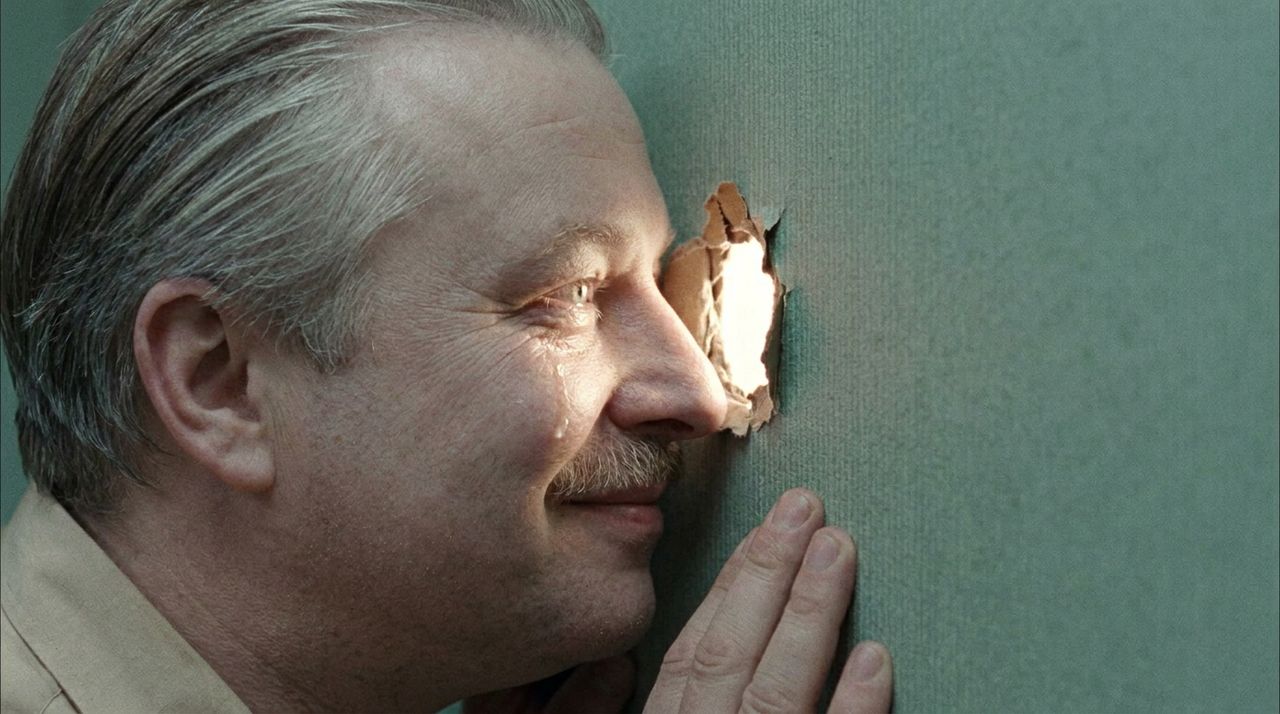
One continuous slow pull-back, no cut. We start on the awestruck eyes of the same middle-aged man, tired wrinkled adult eyes and grey eyebrows, peeking through a small ragged hole in old brown cardboard; the camera glides steadily backwards and the cardboard is revealed to be the side of an old worn unbranded shoebox on a high wooden shelf, beside a glass jar with a twisted branch and a grey stone; the pull-back continues to reveal the bedroom below, the window with two pale suns, and the alien child with a pale grey bald head at the desk, back to us. The face in the hole is ALWAYS the same middle-aged man, never a child; it gets smaller but does not change. Calm, silent. No other people, no text.
Look at the capitalised phrase: "ALWAYS the same middle-aged man, never a child". The first version of this shot turned the man's face into a child's. What the engine tends to do, you forbid by name.
07Test three worlds before you choose
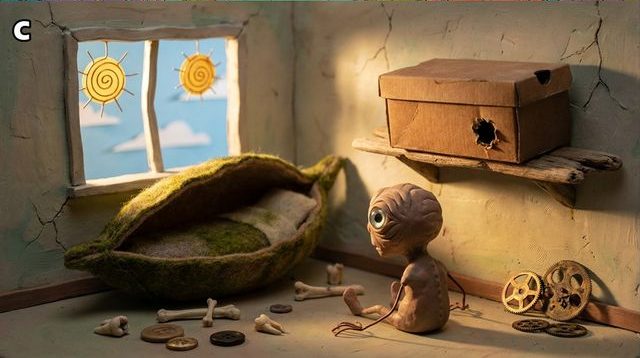
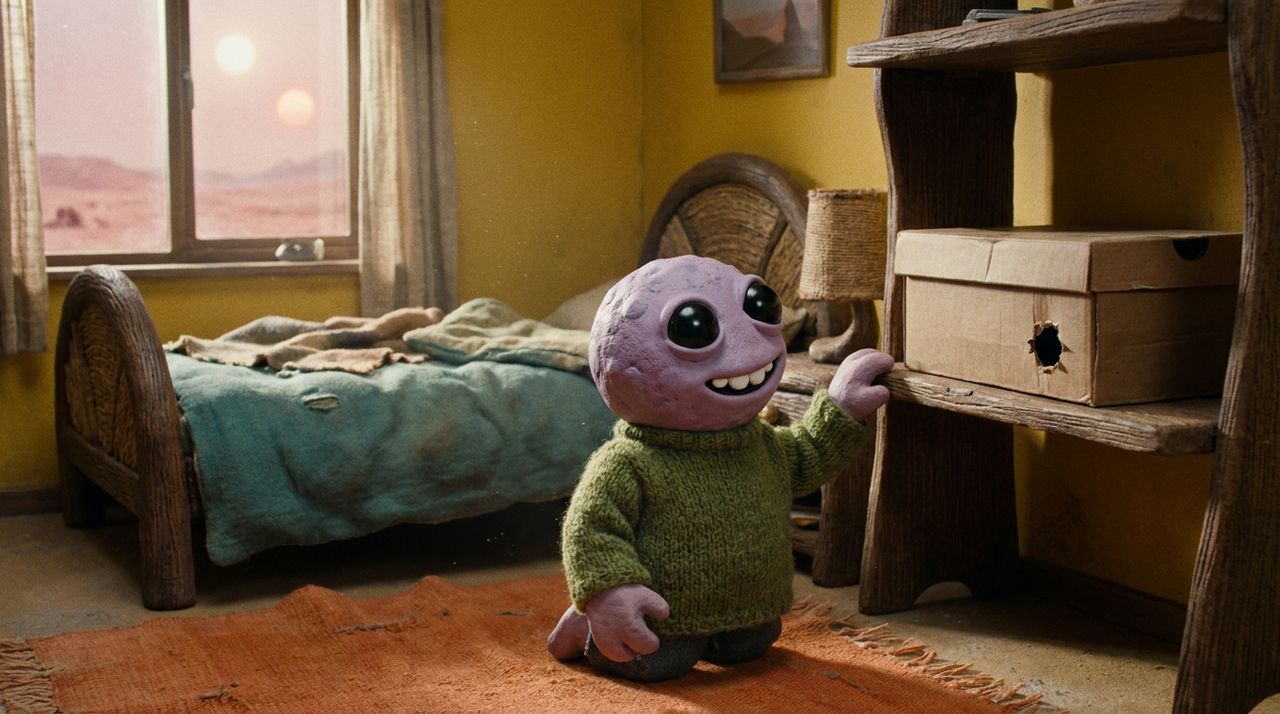
The alien child's room was decided like this: six versions of one base prompt, each with a different film or movement, and I chose by looking at the images instead of reading ideas. Only the style block changes. The rest of the prompt stays identical.
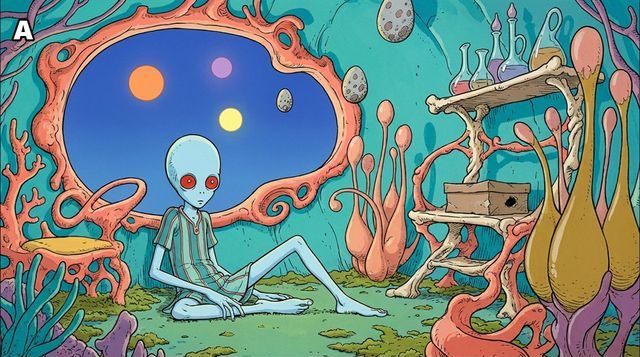
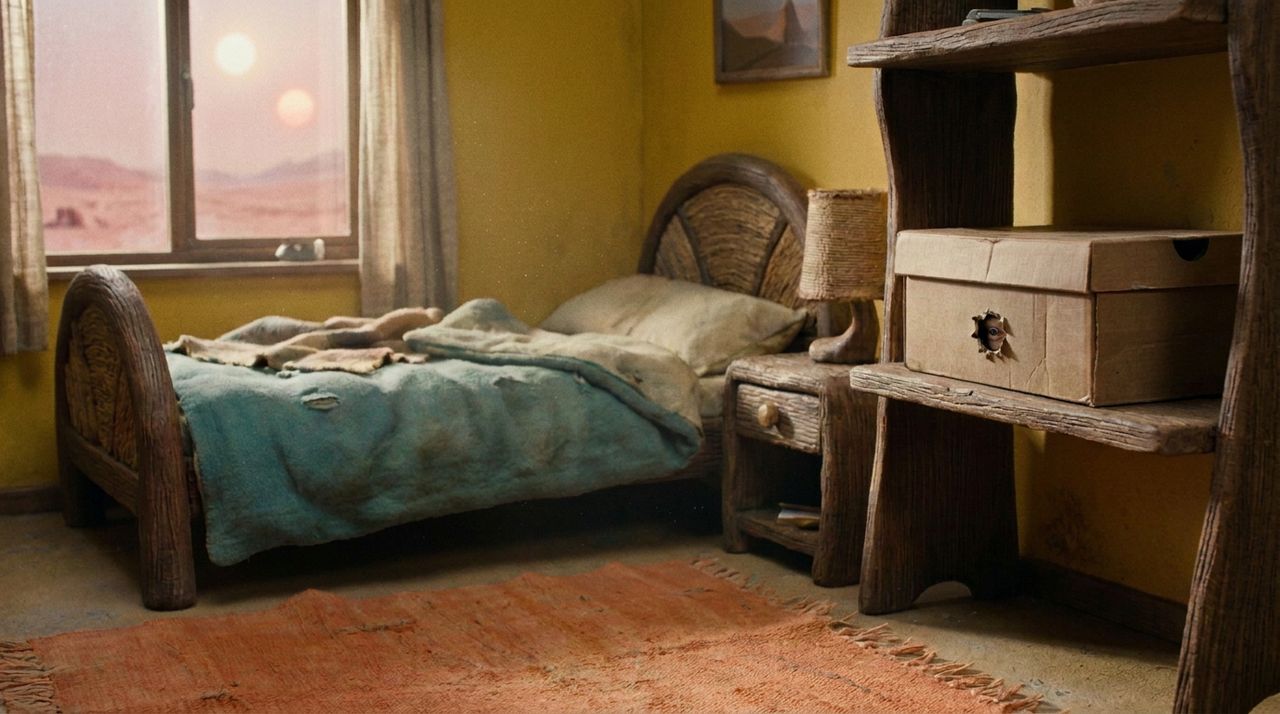
A frame from a 1970s French hand-painted animated science-fiction film, flat gouache colours and fine ink line in the manner of Moebius and René Laloux. A vast surreal alien child's bedroom: an ultramarine sky through an organic window with three suns of different sizes, floating stone eggs, furniture that grows like coral and tall fleshy plants. [...] On a twisted shelf made of bone sits an ordinary old brown cardboard shoebox, drawn realistically, with a tiny ragged hole in its side. Saturated turquoise, coral, mustard and violet palette. No text, no logo.
A frame from a handmade stop-motion animated film, tactile clay, felt, wire and found objects, slightly grotesque and dreamlike in the manner of Jan Svankmajer and the Brothers Quay. An alien child's bedroom built in miniature: lopsided walls of cracked painted clay, a window showing a paper-cut sky with two spiral suns on wires [...]. On a crooked shelf of driftwood sits an ordinary old brown cardboard shoebox with a tiny ragged hole in its side. Warm practical light, visible fingerprints in the clay, shallow miniature depth of field. No text, no logo.
A real photograph of a physical miniature film set, shot like a live-action movie with a real lens and warm practical lighting. An alien child's bedroom where everything is sculpted from smooth glossy plasticine in bold saturated colours [...]. The alien child is an original plasticine puppet [...] wearing a knitted red jumper, sitting at a desk drawing. On a wobbly plasticine shelf sits an ordinary old brown cardboard shoebox, completely real and mundane, with a small ragged hole in its side. Visible fingerprints and tool marks in the clay, real depth of field. No text, no logo.
- My first alien room followed the living room's style (Roy Andersson) and I discarded it: I asked for a completely different, extravagant landscape, and the options came from that.
- Realism works with the strange: the set is a real room with cinema photography and the only unreal thing is the puppet.
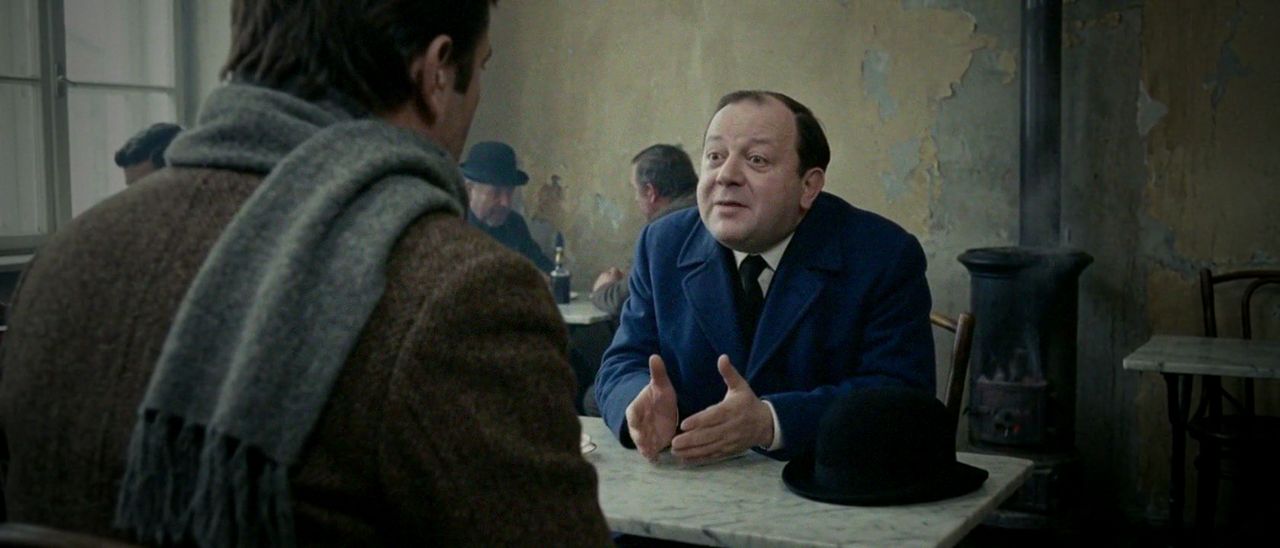
- Every film you cite changes the whole look. For Papini I used Barry Lyndon. For Shoebox, Roy Andersson.
08Test the hard shots first, not the beginning
Before making all 16 shots, I made only three: the high-risk ones. If they don't work, you rethink the short before spending on the rest.
| Shot | What went wrong | What I changed |
|---|---|---|
| P6 · the blow | The fast engine gave an unreal explosion; later the hole came out huge. | Higher-quality engine, first and last frame, and the blow as an insert cut on impact. |
| P12 · the turn | A transition with a fade to white that didn't work. | A continuous half circle from behind his head to his eyes in the cardboard, no fade. |
| P14 · the pull-back | The engine always returned the hole to the size of the face. | A 46x digital zoom over four nested layers (eyes, cardboard patch, box, room). |
09Storyboard and review: look at everything before animating
Generate one frame per shot, put them on a contact sheet and compare them against the bible. If a frame fails, redo ONE with the correction. If it fails again, change the framing. When you animate, look at every take again: the sheet at 2 frames per second and, enlarged to full size, the contacts between objects (hands and object, sparks and knife).
[ ] The face is the anchor's (not a lookalike brother)
[ ] Clothes identical to the bible
[ ] The key object is where the table says
[ ] The set is the same (doors, furniture, light)
[ ] No extra people
[ ] Count fingers, tusks, legs, ears
[ ] The camera is on the axis side
I animate in batches of eight shots at most. Any more and the service returns "Rate limit exceeded". Consecutive shots chain from the last frame of the previous one.
10Sound holds the image up
- One fixed voice per character. The engine speaks the line and then I run it through a fixed voice (voice to voice), which keeps the timing to the millisecond and stops the character changing timbre. Without this, each shot usually has a different voice.
- The engine's native sound sometimes brings a real effect and sometimes an absurd noise. I listen to each take before assembling it.
- Designed by hand: in Shoebox, the room clock, the hammer, the hum of the light, the fall and the alien room's ambience. Music only from the lit face to the end.
- Each character's lines in a single voice take, cut afterwards by words: line by line, you get different voices.
11Audit it yourself before anyone else does
My Shoebox v1 came out with three different men, a hammer blow in an empty room, a storage room that was another room, and a floating fall. I saw them after delivering it. Since then I review first.
[ ] Every shot against the bible
[ ] The end of one shot and the start of the next, side by side
[ ] Jumps inside a take: frame difference
[ ] The whole audio, start to finish, twice
[ ] The music is still there at the end (compare with the previous version)
[ ] Invented text and logos on screen
[ ] Every error an AI reports: confirm it with a frame
An AI that watches video helps me find errors, but it gets things wrong. On Shoebox v2 it gave six warnings: one was real (a hammer that disappeared) and five were false. Check them against frames before redoing anything.
12What it really costs
Budget, and then double the reserve. On Shoebox I estimated about 740 credits with a 30 % retake reserve. By v2 I was at about 1,390, nearly double. Every rejection costs, and what spends the most isn't making the shot but redoing it when it fails between shots.
| Shoebox milestone | Cumulative credits |
|---|---|
| Planned at the start (anchors 20, storyboard 90, closing frames 12, video 445, reserve 170) | 740 |
| Anchors and pilot v1 | 197 |
| Alien-world change | 273 |
| Scale and hammer-blow fix (v3) | 454 |
| Scale zoom (v4) | 515 |
| Full short v1 | 967 |
| Short v2, redone by continuity | 1,392 |
Credits are Previz's, the tool I use. What matters is the proportion: test the hard parts first so you fail cheap.
AI makes the shots.
You still make the film.
If you make one with this blueprint, send it to me in a DM on Instagram: I watch them all.